Seyfeddin Kara has just published his new book, The Integrity of the Quran. Sunni and Shi’i Historical Narratives. It investigates Muslim narratives on Qurʾanic distortion through a meticulous analysis of hadith. Using isnād-cum-matn analysis, Seyfeddin Kara discovers the historical origins of this disputed claim and illuminates the dynamic interplay between Sunni and Shiʿi traditionists. He demonstrates that isnād-cum-matn analysis is not only an important tool for dating hadiths but also crucial for uncovering forgeries. By identifying the individuals responsible, he provides new explanations of forgery culture in early Muslim society. Kara illuminates debates over the textual integrity and evolution of the written Qurʾanic text, offering insights into the enigmatic early history of Islam. By pushing the boundaries of isnād-cum-matn analysis, this book makes methodological advancements in the study of early Islamic history and contributes to its reconstruction on the question of the canonised Qur’an’s integrity.
Western academic scholarship on the origin and transmission of hadith and traditional Muslim hadith methodologies of authentication, though studying the same body of literature, often operate in disconnected universes. It is of scholarly importance to academic development and for the continued vibrancy of the hadith tradition, as practiced by Muslim ulema, that dialogue continues between the two. Conferences aiming to do so, such as the one at Pembroke College, Oxford in 2019 on the topic of Modern Hadith Studies between Arabophone and Western scholarship, are a welcome effort, though the field remains siloed.
Since the academic movement is most closely associated with the work of Harold Motzki from the 1990s, there has been a shift beyond the so-called ‘skeptical’ school with respect to hadith using the technique of ICMA. This method analyses the variation of hadith texts according to their paths of transmission, seeking to provide a reliable date for the time at which a hadith was first in common circulation (as witnessed by its corroborated chains). Scholars with a range of theoretical perspectives have used this methodology to analyze and in particular, date hadiths on various topics. The method is commonly used to recover as much as possible of the hadith corpus as a viable historical source for the first two centuries of Islam, even though the canonical compilations date mainly to the third century and later. Though ICMA has received positive reception, especially in the context of the prior prevailing academic skepticism about hadith, critical voices have been raised. Some scholars have argued for the continuation of a more skeptical attitude towards the transmission of hadith, based on the ways that fabricated reports and chains can enter the corpus. Others have suggested that Motzki’s focus on full textual corroboration does not go far enough and other techniques, including those used within the Islamic intellectual tradition, could be legitimately added to date hadiths earlier still. Finally, some scholars defend the integrity of the canonical hadith collections as a whole.
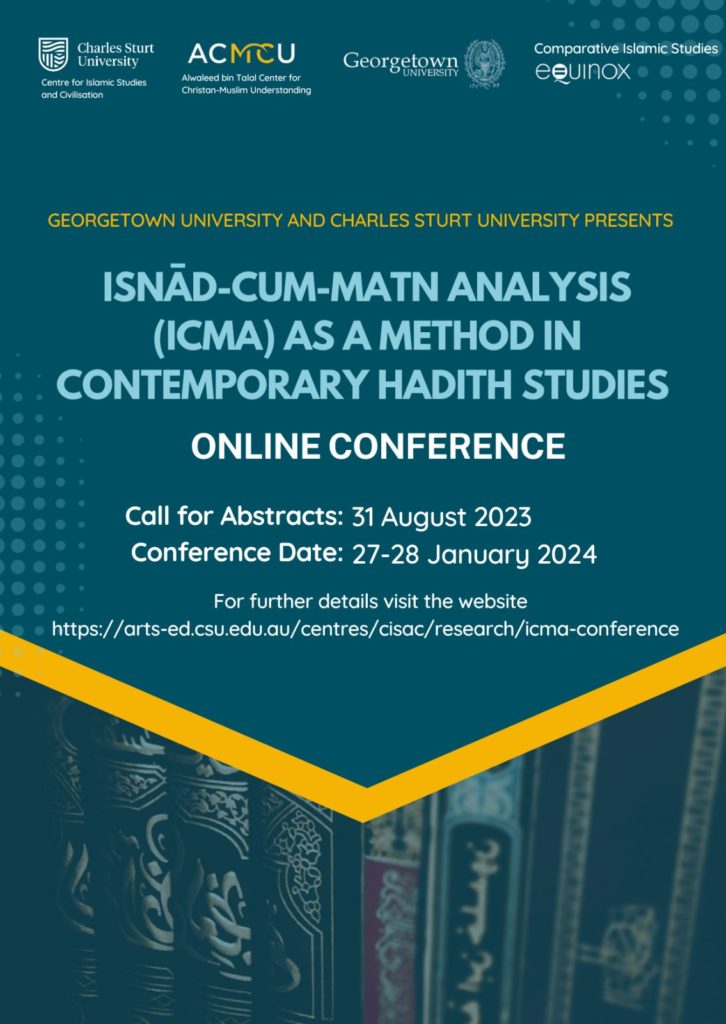
This conference will provide a forum for the assessment of an international group of experts on hadith, from a variety of backgrounds and theoretical perspectives. The intention is to provide a ‘state of the art’ appraisal of ICMA within hadith studies and related academic disciplines, with selected papers published with the blind peer reviewed journal Comparative Islamic Studies.
Send proposals of up to 300 words tosansari@respectgs.usby 31 August 2023, which will be reviewed by members of the organizing committee. Please include relevant affiliation, a 200 word biography and contact information in a single Word document along with the abstract.
Mathieu Tillier has gathered a corpus of epigraphic invocations (duʿāʾ) which he compares with invocation formulae contained in ḥadīth narratives. He covers the first three centuries of Islamic history and anaylses in details what he has coined the “prophetisation” of ḥadīth narratives, whereby formulae attributed to anonymous figure slowly become the saying of companions, successors and finally Muḥammad. His comparative approach, in which he combines lexical and textual analysis, allows him to uncover the rare formulae that could be traced back to the first century of the Islamic era and were preserved untouched in the literature. His scrupulous comparison also highlights the evolution of the different phenomena observed regarding the formulae that remained untouched, those which were attributed to non-prophetic figures and finally the ones which were ‘prophetised’, i.e. attributed to the Prophet Muḥammad. It is to be hoped that this well-documented work will inspire more similar interdisciplinary studies and help us understand better the ḥadīth literature in its historical context.