The Journal of Hadith and Sira Studies in Istanbul has just released its latest issue which can be access on the following page:
http://www.hadithandsira.info/issues/

The Journal of Hadith and Sira Studies in Istanbul has just released its latest issue which can be access on the following page:
http://www.hadithandsira.info/issues/
Dear Colleagues in Hadith Studies,
I would like to share with you the latest publication of our colleague, Ruggero Vimercati Sanseverino, Transmission, Ethos and Authority in Hadith Scholarship: A reading of al-Qāḍī ʿIyāḍ’s (476-544/1083-1149) handbook of hadith science “The Elucidation of the principles of transmission and of the transcription of audition”. The paper is accessible on academia and you will find the abstract below.
Abstract:
In a historical situation marked by the upcoming of divergent figures of religious authority in the Islamic West of the 6th/12th century, the influential Moroccan scholar al-Qāḍī ʿIyāḍ al-Yaḥṣūbī (476-544/1083-1149) authored manual of hadith sciences, the al-ʿIlmāʿ ilā maʿrifat uṣūl al-riwāya wa taqyīd al-samāʿ (The elucidation of the principles of transmission and of the transcription of auditon). The Elucidation is one of the referential texts on the science of hadith in the Sunni tradition and, despite its being the first work of its kind in the Maghreb, it has not yet been the object of academic study in any European language. This study interrogates the text about its conception of the authority of hadith in order to allow for an interpretative reading of its view of hadith transmission. It proceeds by distinguishing five thematical sections in the text concerning respectively the epistemological foundation of hadith transmission, its functional purpose, the techniques and conditions of its authoritativeness and the significance of its ethos. Besides aiming at clarifying the question of the authority of hadith and some of its implications, a further purpose of this study is to present a so far neglected aspect of al-Qāḍī ʿIyāḍ’s scholarship.
Dear all,
I hope that you are all well and enjoying warmer weather than we are here in the North of England!
As many of you will know, as well as completing a Ph.D. on isnad-cum-matn, I have the pleasure of looking after the Islamic studies and antiquity series at Gorgias Press. With the latter role in mind, I am delighted to bring to your attention a new academic project and translation series established by Gorgias Press and the King Faisal Center for Research and Islamic Studies. The project is called the Library of Islamic and Arabic Heritage and will usher in several new series that will introduce new translations, Arabic editions and other interesting things to the field.
The first series within the project is the Classical Islamic Tests Series, which invites interested academics to produce ten short translations of important classical Arabic texts. By short, I mean in the region of up to 350 pages (substantial English introduction + Arabic + English translation). So this will roughly break down to 50 pages for the introduction and 150 pages each for the Arabic and English. A little more or less is not an issue at all.
In terms of the choice of text, we are looking for key texts, such as manuals or chronicles, that researchers would consider important to-hand reference works and useful teaching aids / reading texts. Realising that texts of this length are not always easy to find, you are also welcome to propose sections of larger compendiums that are recognised (or you might argue should be recognised) as important.
In return for your labour, there is a modest but significant pot of gold in the form of a stipend. In addition, your translation will be guaranteed a substantial subvention grant (to make it affordable!), proofreading, a marketing grant and professional copy editing.
We would love for some of the books to be related to hadith and history. So please do throw your hat into the ring if you have something interesting in mind. And feel free to send me an email if you want to have an informal chat.
More details about the editorial board and how to submit can be viewed here.
Best regards,
Adam.
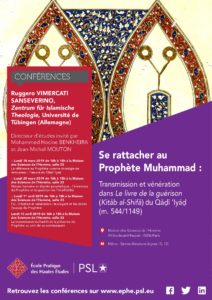
Last session of the conference cycle “Se rattacher au Prophète Muhammad: Transmission et vénération dnas le Livre de la guerison du Qâdî ‘Iyâd (m. 544/1149)” at the École Pratique des Hautes Études in Paris
Pavel Pavlovitch has drawn our attention to a recently published monograph, Studies in Legal Hadith by Hiroyuki Yanagihashi. Having already published extensively on various topics within Hadith studies, the author tackles here “the question of responsiveness […] of hadith to developments in positive law”. He compares analyses of Hadith narratives (both matn and isnād) pertaining to legal debates with related discussions in early legal treatises. This leads him to consider the numerous textual variants of several legal Hadith texts and the reasons for the existence of these discrepancies. His work allowed him to develop a “methodology to estimate the extent to which traditionists accepted hadiths on a particular topic”. Following Andreas Görke and Pavel Pavlovitch inter alia, Hiroyuki Yanagihashi argues that the textual variations of legal Hadith texts reflect in part the constantly evolving positive law. This monograph is contributing to address questions that had long been overshadowed by the problems of authenticity in Western Hadith studies, mainly the multi-layered nature of Hadith texts and the ways historical information can be extracted from them regarding the development of Islamic legal practices and reflections. Thanks to our colleague Raashid Goyal, I was able to read the introduction to this monograph and I can only concur with Pavel Pavlovitch, there is much to await from this reading.

Verifying the attribution of ḥadīth to the Prophet Muhammad (Allah bless him and give him peace) has long preocupied the minds of researchers in Islamic Studies. With this end in sight, many books of ḥadīth were written in the first few centuries. Ṣaḥīḥ al-Bukhārī is without a doubt the most important of these works. For this reason many other books and studies were written on it, both in the past and present. These secondary works focused on specific subtopics within the field of ḥadīth studies and varied both in content and aim. Some of these works focused on the methodology of al-Bukhārī in his Ṣaḥīḥ, while others paid attention to his teachers and students. Other works researched the narrators he included as well as the conditions he applied in choosing them. Another group of researchers decided to focus on the texts of the ḥadīths themselves, in terms of critiquing those texts, understanding them, and analyzing them. And finally, some decided to insted focus on the legal opinions that al-Bukhārī chose in his Ṣaḥīḥ. In addition to all of this, the commentaries written on Ṣaḥīḥ al-Bukhārī are considered exemplary models of commentaries written on ḥadīths.
The great attention Muslim scholars as well as Islamic studies specialists from around the world have given to this text, in terms of historical research, analysis, and study is sufficient to show its value and rank. Despite all of what was mentioned above, historically. some ḥadīth scholars did criticize the text and in our modern day the amount of criticisms has only grown.
Given this context, this symposium aims to study Ṣaḥīḥ al-Bukhārī from all angles: its chapter headings, its mu‘allaqs, its repetitions , its conditions, its methodology in chosing one text over another, the differences in manuscripts, all studies that are related to the text, as well as the criticisms leveled against it.
This conferences also aims to present studies on the topics mentioned above if they have not yet been researched or have not been adequately studied.
Therefore, this conference aims to highlight the following themes:
First: the history of the Ṣaḥīḥ: the social, educational, political, and cultural milieu in which the book was written, as well as the primary sources of the texts, how it was compiled, the effort exerted in its upkeep and preservation, as well as its various manuscripts and their history, and finally historical criticism of the text.
Second: the methodology of al-Bukhārī in his Ṣaḥīḥ: the ordering of the text, the method of selecting chapter headings, his condition of two narrators having actually met, as well as the rest of the conditions that apply to narrators, the conditions he had in judging a ḥadīth to be authentic, and the areas of difference between his work and similar books, as well as his own contributions to the field of ḥadīth methodology.
Third: the ḥadīths of Ṣaḥīḥ al-Bukhārī: critiquing them in terms of isnād and matn (text), analyzing them, studying how and why he quoted parts of them in different areas of the text, as well as appraising these.
Fourth: the commentaries of Ṣaḥīḥ al-Bukhārī: its scientific value, a focus on some of its unique qualities that have not yet been highlighted, and commentaries that have not been given much attention, as well as commentaries that were never completed.
Fifth: Ṣaḥīḥ al-Bukhārī and Islamic Civilization: the role of Ṣaḥīḥ al-Bukhārī in the makeup of Islamic civilization, its place in the cultural history of the Muslim community (public readings), and its importance in our modern day.
Sixth: Criticisms leveled against Ṣaḥīḥ al-Bukhārī: some of the innovators found among its narrators, the place of its mu‘allaqāt, the role of previous books as sources of some of its content without a proper chain connecting them, the reason why some ḥadīths are cited as being part of it when in actuallity they are not found within it, the validity of the claim that some ḥadīths contained within it are weak or fabricated, the validity of the claim that some of its ḥadīths contradict reason or modern science, the accurateness of ascribing him to the Shāfi‘ī school and his distance from the Ḥanafī school.
Ibn Haldun University
Ulubatlı Hasan Caddesi, No:2
34494 – Başakşehir, İstanbul, Turkey
e-Mail: abdussamet.sarikaya@ihu.edu.tr
Tel. +90 212 692 0 212
Pavel Pavlovitch wrote to us the following suggesting two recent publications:
This is an excellent essay with a clear focus on the methodology of studying early ḥadīth including in-depth reflections on Behnam Sadeghi’s ‘Travelling Tradition Test’. The essay clearly shows the advantages and limitations of modern-day isnād– and matn-critical approaches to ḥadīth. To me, the largest challenge of this type of analysis is how to deal with the ubiquity of single-strand isnāds featuring large time gaps between the death dates of successive generations of transmitters. Apart from common links, personal reliability, and geography of dispersal, we must pay close attention to the factor of highness (ʿuluww) in the shaping of these isnāds.
The essay may be downloaded from Luke Yarbrough’s profile at Academia.
The article includes a study of Ibn Sīrīn’s tradition:
Lam yakūnū yasʾalūna ʿan al-isnād. Fa-lammā waqaʿat al-fitna qālū: “Sammū la-nā rijāla-kum fa-yunẓaru ilā ahl al-sunna fa-yuʾkhadhu ḥadīthu-hum wa-yunẓaru ilā ahl al-bidaʿ fa-lā yuʾkhadhu ḥadīthu-hum.”
The examination of its isnāds shows that it was most likely circulated in Baghdad at the beginning of the third century AH, less likely, in Bagdad in the third quarter of the second century AH. The former chronology finds support in the tradition’s matn: The dichotomy ahl al-sunna/ahl al-bidaʿ points to the miḥna as the life setting of Ibn Sīrīn’s statement.
To find out the earliest stage of isnād deployment, I also study a tradition in which Ibrāhīm al-Nakhaʿī states, inna-mā suʾila ʿan al-isnād ayyām al-Mukhtār. This is a solitary tradition, the only version of which is found in Aḥmad’s ʿIlal wa-maʿrifat al-rijāl. Its isnād, Jābir b. Nūḥ (d. 183/799–800) -> al-Aʿmash (d. 147–8/764–5) -> Ibrāhīm al-Nakhaʿī (d. c. 96/715), is impossible to verify.
Nevertheless, I think that both traditions reflect correctly concerns from the end of the first/seventh century, based on two general arguments.
First, Ibn al-Madīnī’s madārāt al-isnād as well as the earliest known common links flourished towards the end of the first century. This suggests that the initial urge to cite one’s informants may be dated in the same period.
Second, the ‘criterion of embarrassment’ suggests that Ibn Sīrīn’s and al-Nakhaʿī’s statements, although possibly inauthentic with respect to their earliest speakers, may reflect the actual chronology of the isnād’s emergence, because they contradict the established narrative, which sees the event as a consequence of the first civil war.
In the Conclusion, I propose to consider the formation of the isnād as a process that took a century to accomplish. Furthermore, the isnād in legal traditions and isnād historical akhbār developed at different paces, and these two developments should not be subsumed under a common chronological and typological denominator.
The article may be downloaded from the web page of al-Qantara or from my profile at Academia.
Kind regards,
Pavel Pavlovitch